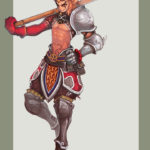
While unfortunately the article does take a focus on events over details of the characters, it’s important to note that all the games listed as positive changes are ones that avoid (at least mostly) the bikini armor trope. This isn’t coincidental.
The vast majority of the time the visual representation of your character is the first impression on the audience, and hence essentially their introduction. Characters hamstrung with an generic introduction of “well she’s sexy like a lingerie model and dresses like one too” are, at best, going to have fight an uphill battle to be taken seriously or seen as interesting in a long over-saturated marketplace.
If, however, you start with trying to make them interesting and let the visual grow as a reflection of the character – then you open yourself up to all kinds of possibilities.
Of course. A lot of the armor that is on display in museums and owned by private collectors (and hence shown in books) was purely ornate and never intended to be worn into battle. After all, not setting foot on a battlefield does help improve the chances of your armor not being destroyed.
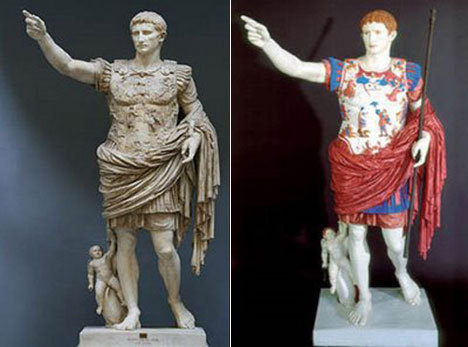
Prior to firearms, crossbows and other innovations making heavy armor redundant, it was commonplace for rich leaders who didn’t actually set foot on the battlefield to decorate their armor. Roman Emperors in particular seemed fond of looking absolutely fabulous in armor.
Ancestral armor was not really a thing in most places because generally a memorable suit of armor was part of an individual’s identity. A noble’s armor were also unlikely to fit their heirs – outside of Disney movies few families have identical measurements from generation to generation. Finally there was the issue that armor adapted as weapons did – wearing the previous generation’s armor exposed you to the current generation’s weapons.
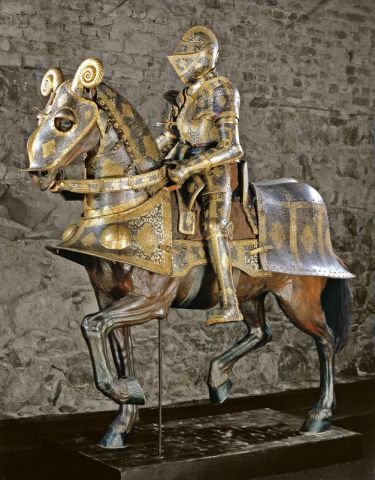
The armor above was made for Sigismund II Augustus, the then King of Poland (who it seems probably never set foot on a battlefield) – and was one of twenty private armors owned by him at the time of his death. It would not have been unusual for a noble wearing such as suit in a parade to accessorize with a sash and/or long cape.
The important part about purely ornate armor is that it looks like armor – just with decorations that go beyond being practical. They still reflect the core armor values of the era but they’re just over decorated*, questionable accessorized and may have reductions made to facilitate their non-combat use (such as no gauntlets or arm protection if it’s for wearing to dinners and parties).
I thought we’d bring this one back as the reminder that there’s no reason that fabulous looking armor can’t be (at least semi-)practical looking armor… just with more fabulous.