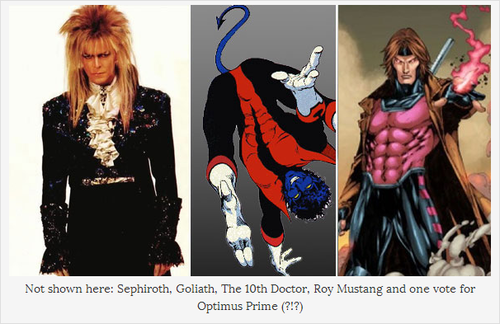
This is one of the most common deflections when the issue of how women are portrayed comes up. It’s known as a false equivalence – the idea that two things presented together as equal when in fact they aren’t. In this case, the idea that just because women have exaggerated physiques doesn’t mean they’re sexist because the men are just as exaggerated too. Of course, this doesn’t work for many reasons. To start with, it assumes – falsely – that the things that women find sexy are the same things that guys find sexy; that is, the exaggerated secondary sex characteristics. But we’ll get to that in a second.
The other issue is the reason for the exaggeration. Comics and games are fantasy true, but the fantasy aspect differs when it comes to male and female characters. Male characters are a power fantasy; the large muscles and massive torsos are visual signs that this character is an unstoppable powerhouse. Kratos doesn’t look the way he does because Sony Computer Entertainment did focus-market studies and found that women reacted best to that design; he looks the way he does because he represents the powerful alpha-male that gamers want to be.
The women, on the other hand, are sexual fantasies. These are the rewards for the player – the character’s love-interest, the motivation to complete the game. They’re designed as eye-candy; they’re intended as something to be consumed, not something to escape into. Women like to fantasize about being desirable yes, but they also like to be powerful, and their definition of what they would consider to be sexy and powerful doesn’t mean battle-bikinis and thongs of power.
But hey, I’m a guy. It’s easy for me to sit here and proclaim what women find sexy, but I could be talking out of my ass. So why not take it to the source? I put out a completely unscientific poll on Facebook and Twitter about characters that women find sexy – video games, comics, anime, whatever. And the results? Well, let’s compare.
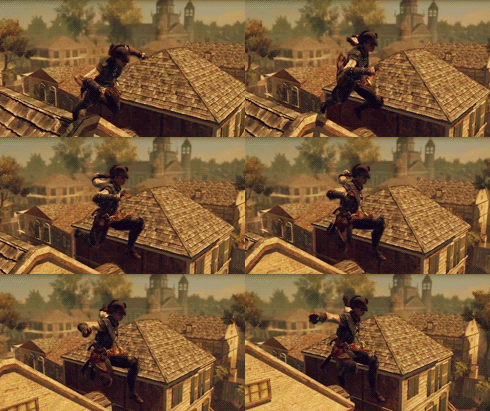
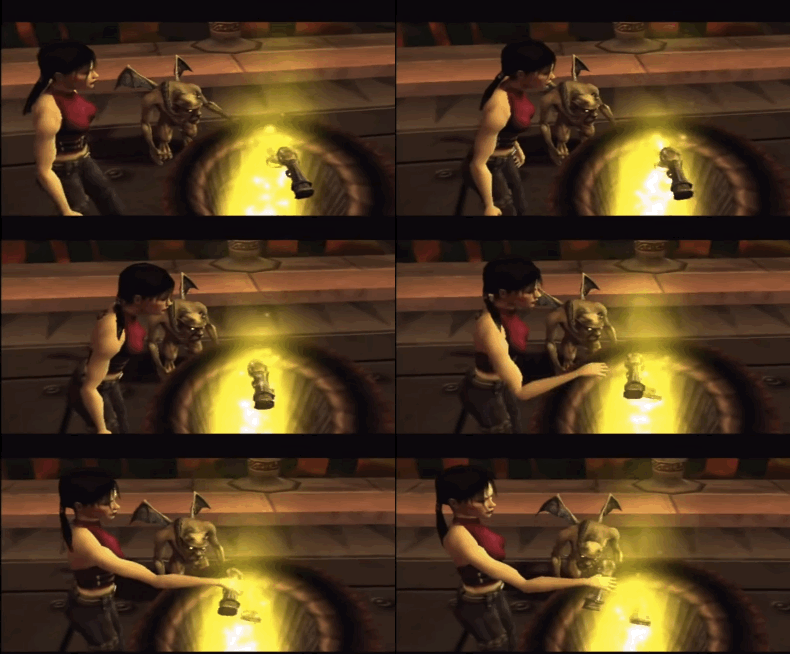
Up top we have the exaggerated figures that are supposedly sexy.
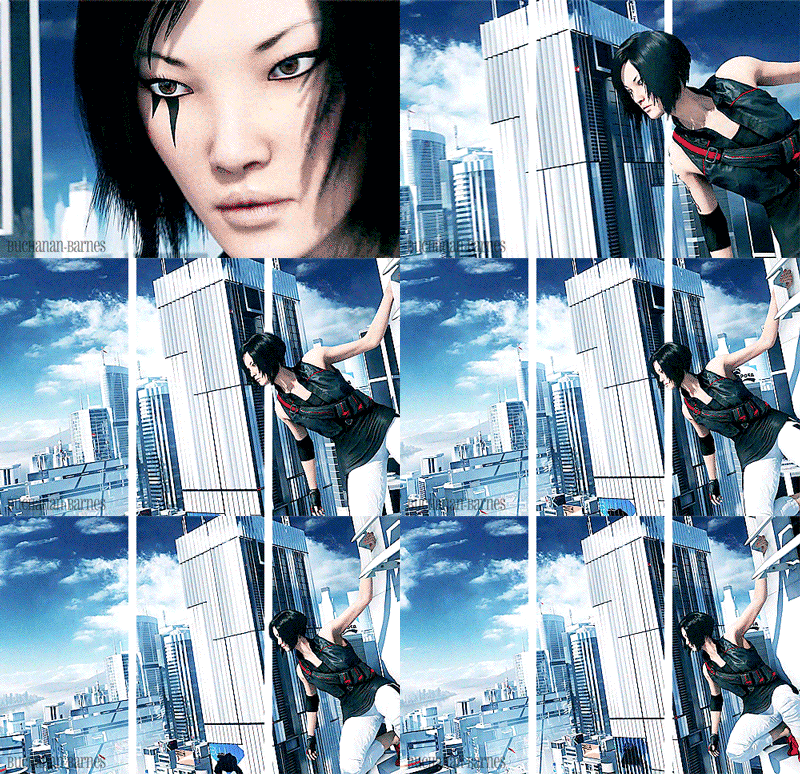
And here are the characters my female readers find sexy:
Notice a trend here? These are not the massive beefcakes alpha-males that are supposedly as equally objectified as Kasumi, Ayane or Ivy. These men have longer torsos with much leaner builds; they’re built like swimmers rather than weight-lifters. They’re not men who scream “unstoppable physical power”. They’re lithe and dextrous, not barrel-chested juggernauts with treestumps for limbs.
And the other critical factor: it’s not just their builds that make them sexy. Gambit, for example is attractive because of his personality and his situation; he’s tortured because he can’t physically touch the woman he loves. Nightcrawler is the laughing swashbuckler, full of wit and flirty charm. Jareth is dark and mysterious and just a little dangerous and oozes sexuality.
Yes, the men are exaggerated as much as the women. But it’s the intent and the message that make all of the difference.
The part I find most baffling about the claims that men suffer from the same objectification and sexualization as women is I can never, for the life of me, think of a popular product that has:
Plot essential scenes taking place inside a male strip bar, a strip bar that is introduced with loving panning shots over the performers bodies.
Sincere marketing campaigns for non-romantic productions focusing entirely on the sexual characteristics and flirtatious manner of the male lead.
A scandal where it turns out the creators accidentally released imagery of a male lead nude, imagery that never needed to be created for the production in the first place.
A video game rumor that there’s a key function to unlock “naked mode” so you can see the male protagonist running around naked
Part of the reason why some people seem to think that men are sexualized is, ironically, because male sexuality is so rarely put on display as enticement that it creates a mirage effect. People who assume it must be there start seeing it everywhere rather than realizing it’s just not there.
Bringing this back – but also expanding on it because if there’s one thing we’ve learned, it’s that people in denial will desperately cling to Raiden in Metal Gear Solid 2: Sons of Liberty having a brief section where he’s stripped naked in the final leg of the game.
Of course, Raiden isn’t sexualized in this section, it’s not a random skin flash like the female characters in Metal Gear games are subjected to and he doesn’t breathe though his skin. It’s actually got a very specific storytelling purpose. Don’t believe me?
And of course, for those who keep insisting that various Snakes wearing skin tight outfits when they sometimes have their ass in the frame as part of the game mechanics – (MGSV spoilers in vid) his flaunting is strictly amateur.
Samus has both the issue of the long standing tradition of “the better you play the more undressed you get to see her” and well, her inclusion in Super Smash Bros.
So yeah, while there are more heroines we could add to this list – it’s kind of a shame that 20% of those on the list have exceptions.
– wincenworks
* We should stress, the issue here is not Go-Go Dancing itself, but rather that this was awkwardly shoehorned into the for no reason other than they wanted to have a conventionally attractive woman in a fetish outfit dancing. Seriously – this is not a reasonable way to obtain a cat-burglary costume with security countermeasures inbuilt.
This is a very special submission that is a really, really in depth discussion of everything about mail (commonly referred to as chainmail). Due to being so in depth, it’s also quite long so I’ve placed it behind a cut. It covers:
The origins and history of mail
How mail actually protects you
How it evolved throughout history and improvements in armor
Examples of mail as worn by different cultures
References and links for further study
If you’re a creator interested in knowing more about mail so you can incorporate it in stories, designs or any other production – I highly recommend this article.
This series of articles will try to explain in simple terms how several types of historical body armor function and are supposed to look like. I will mostly focus on Europe from late antiquity onward, though I may have a few things to say about Middle-Eastern and East Asian armor. This first part will focus on mail armor.
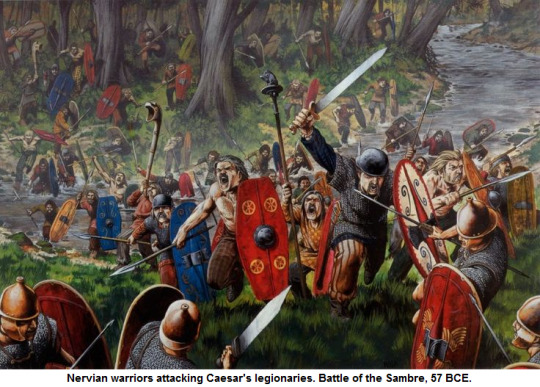
It goes all the way back to at least the fourth century BCE, and it’s widely believed to have been invented by the Celts. The oldest example found so far comes from the tomb of a Dacian chieftain in Romania. It was extremely rare for a warrior to be clad in mail back in those days, perhaps only reserved for chieftains or champions. Celtic warriors who couldn’t afford armor simply wore regular clothes, though some went into battle topless or even naked to avoid the risk of infection from fabric entering their wounds.
Soon the Romans adopted mail and it became the standard armor for their soldiers. Through them it reached the Sassanid Empire and the entirety of Asia. It remained the most popular and common type of armor all the way to the late middle ages. Even during the Renaissance it was used to complement other types of European armor, and in some middle-eastern countries like India, Turkey or Iran it was still being used by the nineteenth century.
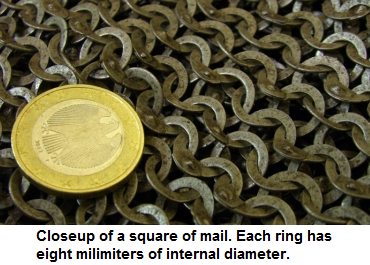
Mail armor at its most basic is a flexible sheet of metal formed by a series of interlinked rings. The most common pattern is nowadays known as four-in-one, where each ring is linked to four other, but most Japanese mail had a six-in-one pattern. Three different types of rings can be identified in historical mail: butted, riveted and solid. Butted and riveted rings were made from drawn wire, while solid rings were punched from sheets of metal. Sometimes brass or gilded rings were used at the edges for decorative purposes.
Butted rings are simply short segments of wire bent into a circular shape. It was mainly used in East Asian mail. In most examples the ends have nothing keeping them closed, but Japanese butted mail has the ends twisted together to give the rings strength. Riveted rings have the ends of the wire secured together with a rivet. Solid rings are simply punched from a sheet of metal and require no further shaping, but because they are closed they need riveted rings to keep them together. Mail armor made from a combination of riveted and solid rings first appeared in the Roman army, and remained in use from then on. Rings of different sizes could be used to make a piece of mail armor, larger rings were lighter, but smaller rings provided more protection by leaving less gaps between then, and so they were used to cover more important areas.
Mail behaves in a very peculiar way when worn. The mesh has a grain, which means it has to be worn the right way up for it to work at full potential. It hugs the body to some degree, but not in the same way a skin-tight shirt would. If anything it hangs close to the body like a heavy woolen garment. This also closes the gaps of the rings, making the armor more effective. The mesh would have some degree of transparency, allowing for any material underneath to be seen from up close. A shirt of mail is very comfortable to wear compared to other types of armor. It allows your body to breathe, it’s extremely flexible and it can act as a heat sink. Wearing mail directly over the skin would be very uncomfortable and may cause chafing or painful friction, so it was always worn over some kind of lining, padding or clothes. It rests most of its weight on the wearer’s shoulders, but this can be reduced by wearing a tight belt over it.
Mail armor works by stopping cuts and thrusts by virtue of the strength of its rings and the shock-absorbing effect of the mesh. While thrusts are somewhat more effective than cuts against it, one would need a very narrow and very rigid point to go between the rings. Even then, in order to get deep enough to wound the person underneath, one would have to burst the rings open, and the friction of metal against metal absorbs a lot of energy by itself.
The earliest examples of mail armor are simple sleeveless tunics that covered the torso all the way down to the hips. This design remained consistent through the Roman era as the lorica hamata, worn by cavalry and infantry, though for the legionaries it was temporarily replaced by the lorica segmenta during the first, second and in some regions the third centuries. Legionaries and cavalry sometimes wore two layers of mail on their shoulders, as a U-shaped cape that was held at the front with a brooch. The tunic eventually became slightly longer and developed short sleeves to fully cover the shoulders. It is possible that the Romans wore some sort of padded garment underneath their mail, but I haven’t been able to find any reliable evidence for that so far.
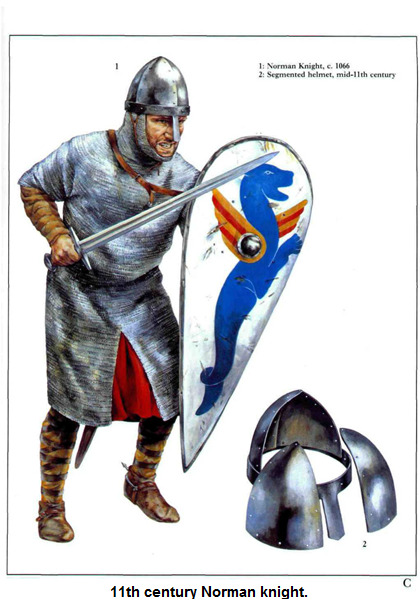
After the fall of Rome armor was once again rare amongst European warriors, but not as rare as it had been at its conception. Infantry formations would be defined by where the mail-clad soldiers were position, usually on the front ranks or at the flanks. Elbow-length sleeves were already common by the tenth century, and by the eleventh century the neck of the tunic was very often extended upwards to form an integral hood or coif. Sometimes a strip or square of mail hanged loose from the front of the hood, and could be raised and tied with tongs to cover the chin or mouth. This was called a ventail. The tunic was now long enough to cover the knees, and it was often split on the front up to just below the crotch, to make it easier to wear while riding a horse. This hooded tunic was then called a hauberk. It’s worth mentioning that hair tangles very easily with mail. Norman warriors cut their hair very short and shaved the back of their heads. It’s also possible they wore leather or fabric hoods under their mail coifs.
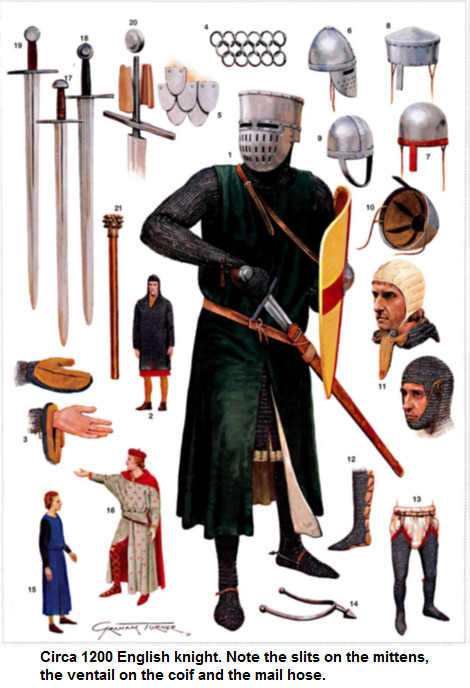
By the twelfth century, after the First Crusade, the sleeves of mail covered the entirety of the arm and often ended in a leather mitten, with the back of the hand covered in mail and a slit on the palm in case the knight needed the use of his fingers. The hauberk was commonly worn over a padded garment called a gambeson, which will be described in detail further on. A similarly padded cap was worn under the mail coif. These two added an extra degree of shock absorption to the mail, and provided a cut-resistant barrier if the rings of the mail were compromised. The legs and feet were also covered by a hose of mail tied at the back with tongs.
These were called chausses. Infantry soldiers wore similar armor, though sometimes without the coif or the mittens.
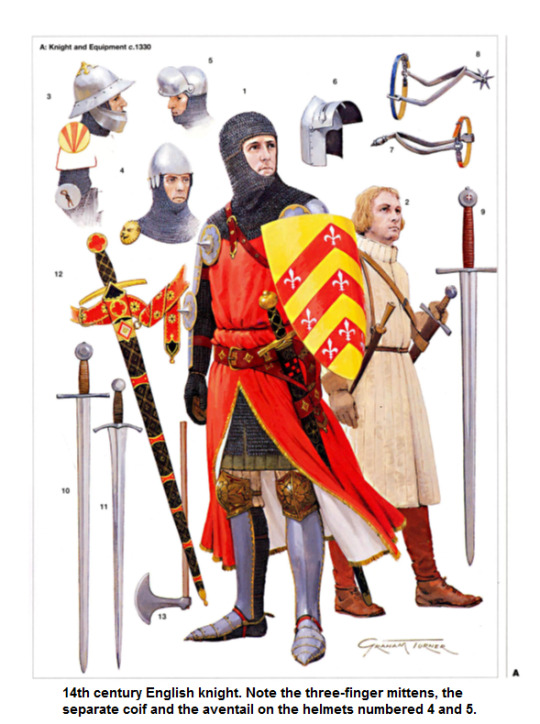
By the latter half of the thirteenth century the mail coif became separated from the hauberk, and the sleeves sometimes ended in three-finger mittens. These mittens would soon be dropped in favor of the gauntlet. The coat of plates had just been developed, but mail was invariably worn underneath it. Mail was also used to protect horses, always over some sort of padding or lining, but it was only done by the heaviest cavalry. It was also used to reinforce reins. By the end of the fourteenth century, when the solid breastplate had already come into the scene, European mail body-armor could be separated into three forms. The hauberk was the knee-length tunic with long sleeves. The haubergeon had elbow-length sleeves and covered roughly half of the thighs. A shirt of mail with very short sleeves that goes down to the hips is sometimes called a byrnie, but the term can also be applied to any tunic of mail. Broad strips of mail over padding could also be used to protect the neck by hanging from the edge of a helmet. This was called an aventail. Sometimes these had flaps that could be used to cover the face in battle and dropped when needed.
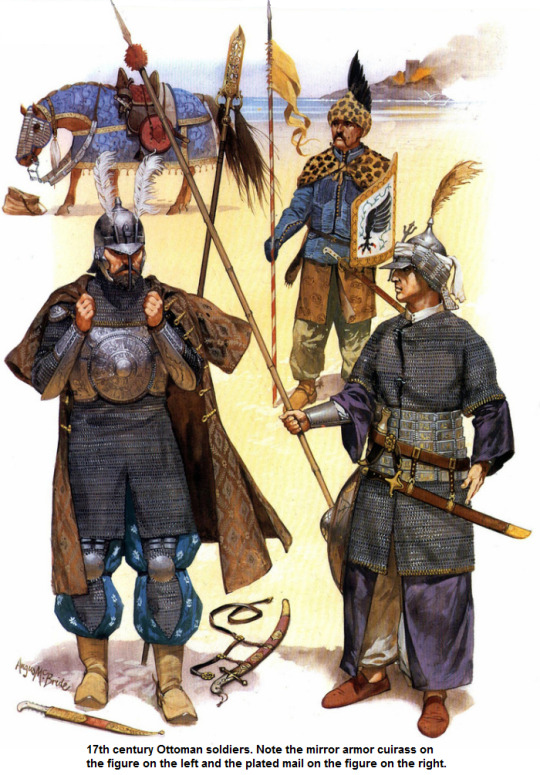
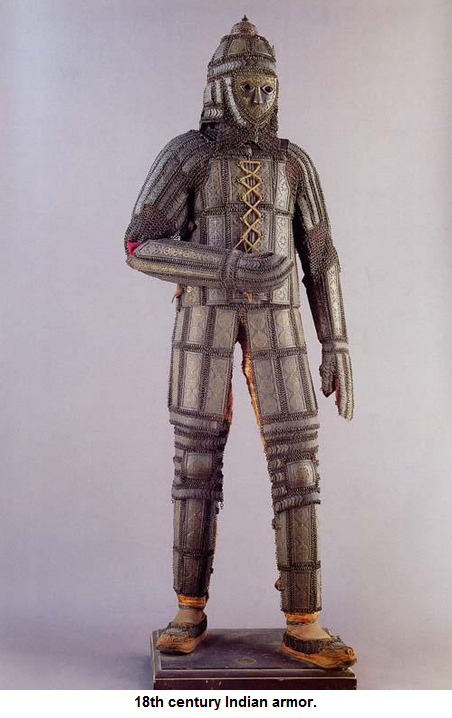
At this point it’s worth mentioning a type of armor often known was plated mail. This is simply mail armor in which metal plates replace the steel rings in certain areas, particularly around the torso. It was also used to protect the horses of heavy cavalry soldiers. This type of armor was very common in Asia and Eastern Europe, most likely popularized by the Mongols of the Golden Horde, and remained in use for centuries to come. The Japanese would develop this type of armor into the karuta tatami do, a cuirass of plated mail with a fabric backing. In the Middle East this would evolve into what’s called mirror armor, a cuirass of large plates connected with mail.
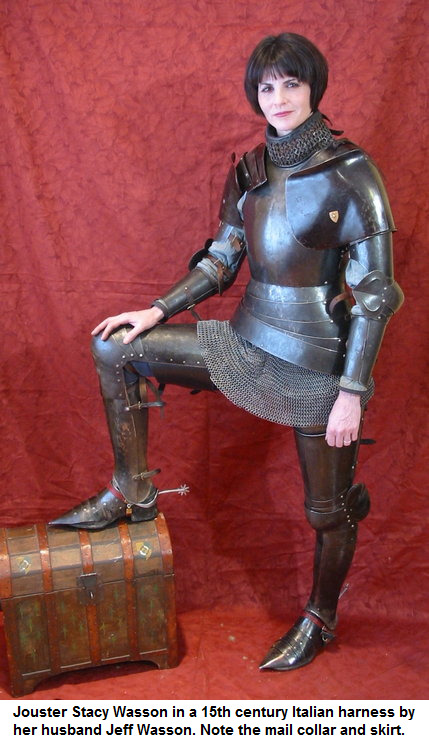
Going back to Europe, the hauberk remained in use together with the new plate armor, but this changed by the middle of the fifteenth century. While the tunics remained popular amongst more lightly armored soldiers, fully armored soldiers only used mail in the shape of sleeves, hose, collars or skirts to cover the gaps in the full plate harness. Horse armor was also made of steel plates, with mail used to cover the gaps.
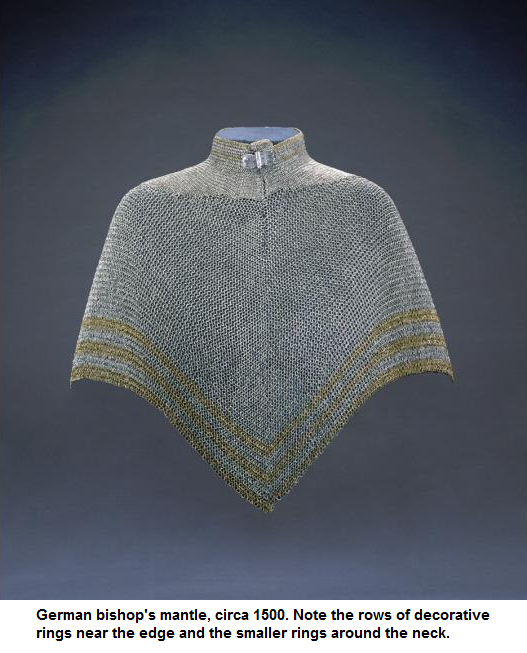
During the sixteenth century the collar, hose and finally the skirt were phased out as plate armor became more complex. Mail was also used in what can be considered auxiliary armor, like a circle of mail that covered the neck and shoulders known as bishop’s mantle. Some light cavalry still used hauberks, like the Italian stradioti and the Polish-Lithuanian pancerni, as well as all kinds of irregular troops. This practice continued through the seventeenth century. The gallowglass, elite Irish infantry soldiers, also favored the long hauberk and the bishop’s mantle, even nearing the end of the sixteenth century.
The use of mail by Europeans dwindled almost into nonexistence with the eighteenth century. The only significant use it saw was in the shape of a sheet of mail made of very small rings, meant to be concealed under one’s clothes as a defense against dueling weapons, but even then it was rare at best. By contrast, mail armor remained a popular form of defense in Asia even well into the nineteenth century. India in particular is a good example of this. The numerous conflicts involving the various Indian factions and the British Empire saw a large amount of close-quarters combat, since Indian armies still favored melee weapons. Mail tunics were common, but so were amazingly elaborate examples of plated mail and mirror armor.
This is a very special submission that is a really, really in depth discussion of everything about mail (commonly referred to as chainmail). Due to being so in depth, it’s also quite long so I’ve placed it behind a cut. It covers:
The origins and history of mail
How mail actually protects you
How it evolved throughout history and improvements in armor
Examples of mail as worn by different cultures
References and links for further study
If you’re a creator interested in knowing more about mail so you can incorporate it in stories, designs or any other production – I highly recommend this article.
This series of articles will try to explain in simple terms how several types of historical body armor function and are supposed to look like. I will mostly focus on Europe from late antiquity onward, though I may have a few things to say about Middle-Eastern and East Asian armor. This first part will focus on mail armor.
It goes all the way back to at least the fourth century BCE, and it’s widely believed to have been invented by the Celts. The oldest example found so far comes from the tomb of a Dacian chieftain in Romania. It was extremely rare for a warrior to be clad in mail back in those days, perhaps only reserved for chieftains or champions. Celtic warriors who couldn’t afford armor simply wore regular clothes, though some went into battle topless or even naked to avoid the risk of infection from fabric entering their wounds.
Soon the Romans adopted mail and it became the standard armor for their soldiers. Through them it reached the Sassanid Empire and the entirety of Asia. It remained the most popular and common type of armor all the way to the late middle ages. Even during the Renaissance it was used to complement other types of European armor, and in some middle-eastern countries like India, Turkey or Iran it was still being used by the nineteenth century.
Mail armor at its most basic is a flexible sheet of metal formed by a series of interlinked rings. The most common pattern is nowadays known as four-in-one, where each ring is linked to four other, but most Japanese mail had a six-in-one pattern. Three different types of rings can be identified in historical mail: butted, riveted and solid. Butted and riveted rings were made from drawn wire, while solid rings were punched from sheets of metal. Sometimes brass or gilded rings were used at the edges for decorative purposes.
Butted rings are simply short segments of wire bent into a circular shape. It was mainly used in East Asian mail. In most examples the ends have nothing keeping them closed, but Japanese butted mail has the ends twisted together to give the rings strength. Riveted rings have the ends of the wire secured together with a rivet. Solid rings are simply punched from a sheet of metal and require no further shaping, but because they are closed they need riveted rings to keep them together. Mail armor made from a combination of riveted and solid rings first appeared in the Roman army, and remained in use from then on. Rings of different sizes could be used to make a piece of mail armor, larger rings were lighter, but smaller rings provided more protection by leaving less gaps between then, and so they were used to cover more important areas.
Mail behaves in a very peculiar way when worn. The mesh has a grain, which means it has to be worn the right way up for it to work at full potential. It hugs the body to some degree, but not in the same way a skin-tight shirt would. If anything it hangs close to the body like a heavy woolen garment. This also closes the gaps of the rings, making the armor more effective. The mesh would have some degree of transparency, allowing for any material underneath to be seen from up close. A shirt of mail is very comfortable to wear compared to other types of armor. It allows your body to breathe, it’s extremely flexible and it can act as a heat sink. Wearing mail directly over the skin would be very uncomfortable and may cause chafing or painful friction, so it was always worn over some kind of lining, padding or clothes. It rests most of its weight on the wearer’s shoulders, but this can be reduced by wearing a tight belt over it.
Mail armor works by stopping cuts and thrusts by virtue of the strength of its rings and the shock-absorbing effect of the mesh. While thrusts are somewhat more effective than cuts against it, one would need a very narrow and very rigid point to go between the rings. Even then, in order to get deep enough to wound the person underneath, one would have to burst the rings open, and the friction of metal against metal absorbs a lot of energy by itself.
The earliest examples of mail armor are simple sleeveless tunics that covered the torso all the way down to the hips. This design remained consistent through the Roman era as the lorica hamata, worn by cavalry and infantry, though for the legionaries it was temporarily replaced by the lorica segmenta during the first, second and in some regions the third centuries. Legionaries and cavalry sometimes wore two layers of mail on their shoulders, as a U-shaped cape that was held at the front with a brooch. The tunic eventually became slightly longer and developed short sleeves to fully cover the shoulders. It is possible that the Romans wore some sort of padded garment underneath their mail, but I haven’t been able to find any reliable evidence for that so far.
After the fall of Rome armor was once again rare amongst European warriors, but not as rare as it had been at its conception. Infantry formations would be defined by where the mail-clad soldiers were position, usually on the front ranks or at the flanks. Elbow-length sleeves were already common by the tenth century, and by the eleventh century the neck of the tunic was very often extended upwards to form an integral hood or coif. Sometimes a strip or square of mail hanged loose from the front of the hood, and could be raised and tied with tongs to cover the chin or mouth. This was called a ventail. The tunic was now long enough to cover the knees, and it was often split on the front up to just below the crotch, to make it easier to wear while riding a horse. This hooded tunic was then called a hauberk. It’s worth mentioning that hair tangles very easily with mail. Norman warriors cut their hair very short and shaved the back of their heads. It’s also possible they wore leather or fabric hoods under their mail coifs.
By the twelfth century, after the First Crusade, the sleeves of mail covered the entirety of the arm and often ended in a leather mitten, with the back of the hand covered in mail and a slit on the palm in case the knight needed the use of his fingers. The hauberk was commonly worn over a padded garment called a gambeson, which will be described in detail further on. A similarly padded cap was worn under the mail coif. These two added an extra degree of shock absorption to the mail, and provided a cut-resistant barrier if the rings of the mail were compromised. The legs and feet were also covered by a hose of mail tied at the back with tongs.
These were called chausses. Infantry soldiers wore similar armor, though sometimes without the coif or the mittens.
By the latter half of the thirteenth century the mail coif became separated from the hauberk, and the sleeves sometimes ended in three-finger mittens. These mittens would soon be dropped in favor of the gauntlet. The coat of plates had just been developed, but mail was invariably worn underneath it. Mail was also used to protect horses, always over some sort of padding or lining, but it was only done by the heaviest cavalry. It was also used to reinforce reins. By the end of the fourteenth century, when the solid breastplate had already come into the scene, European mail body-armor could be separated into three forms. The hauberk was the knee-length tunic with long sleeves. The haubergeon had elbow-length sleeves and covered roughly half of the thighs. A shirt of mail with very short sleeves that goes down to the hips is sometimes called a byrnie, but the term can also be applied to any tunic of mail. Broad strips of mail over padding could also be used to protect the neck by hanging from the edge of a helmet. This was called an aventail. Sometimes these had flaps that could be used to cover the face in battle and dropped when needed.
At this point it’s worth mentioning a type of armor often known was plated mail. This is simply mail armor in which metal plates replace the steel rings in certain areas, particularly around the torso. It was also used to protect the horses of heavy cavalry soldiers. This type of armor was very common in Asia and Eastern Europe, most likely popularized by the Mongols of the Golden Horde, and remained in use for centuries to come. The Japanese would develop this type of armor into the karuta tatami do, a cuirass of plated mail with a fabric backing. In the Middle East this would evolve into what’s called mirror armor, a cuirass of large plates connected with mail.
Going back to Europe, the hauberk remained in use together with the new plate armor, but this changed by the middle of the fifteenth century. While the tunics remained popular amongst more lightly armored soldiers, fully armored soldiers only used mail in the shape of sleeves, hose, collars or skirts to cover the gaps in the full plate harness. Horse armor was also made of steel plates, with mail used to cover the gaps.
During the sixteenth century the collar, hose and finally the skirt were phased out as plate armor became more complex. Mail was also used in what can be considered auxiliary armor, like a circle of mail that covered the neck and shoulders known as bishop’s mantle. Some light cavalry still used hauberks, like the Italian stradioti and the Polish-Lithuanian pancerni, as well as all kinds of irregular troops. This practice continued through the seventeenth century. The gallowglass, elite Irish infantry soldiers, also favored the long hauberk and the bishop’s mantle, even nearing the end of the sixteenth century.
The use of mail by Europeans dwindled almost into nonexistence with the eighteenth century. The only significant use it saw was in the shape of a sheet of mail made of very small rings, meant to be concealed under one’s clothes as a defense against dueling weapons, but even then it was rare at best. By contrast, mail armor remained a popular form of defense in Asia even well into the nineteenth century. India in particular is a good example of this. The numerous conflicts involving the various Indian factions and the British Empire saw a large amount of close-quarters combat, since Indian armies still favored melee weapons. Mail tunics were common, but so were amazingly elaborate examples of plated mail and mirror armor.
Not only does this article have a brilliant title, it also explains very well the false dychotomy of feminist media criticism.
Notable quotes:
We’ve fallen into an all-or-nothing rut with feminist criticism lately. Battle lines are immediately drawn between movies that are “feminist” (i.e. “good”) and “sexist” (i.e. “bad”). And that simplistic breakdown is hurting our ability to actually talk about this stuff.
Feminist criticism isn’t about ripping something to shreds or making others feel guilty for liking it. It’s simply about pointing out a specific creative weakness and then taking that a step further to explain the real-world social ramifications of that weakness, all in the hopes of dissuading future filmmakers from making the same mistake.
I dedicate this article to every single person who ever implied that by criticizing female character designs, we’re apparently disapproving of the whole product those characters are featured in*.
Cause, again:
~Ozzie
*Sometimes we do, but it takes some special levels of terribad to make us write off the whole product, not only its treatment of female characters.
Not only does this article have a brilliant title, it also explains very well the false dychotomy of feminist media criticism.
Notable quotes:
We’ve fallen into an all-or-nothing rut with feminist criticism lately. Battle lines are immediately drawn between movies that are “feminist” (i.e. “good”) and “sexist” (i.e. “bad”). And that simplistic breakdown is hurting our ability to actually talk about this stuff.
Feminist criticism isn’t about ripping something to shreds or making others feel guilty for liking it. It’s simply about pointing out a specific creative weakness and then taking that a step further to explain the real-world social ramifications of that weakness, all in the hopes of dissuading future filmmakers from making the same mistake.
I dedicate this article to every single person who ever implied that by criticizing female character designs, we’re apparently disapproving of the whole product those characters are featured in*.
Cause, again:
~Ozzie
*Sometimes we do, but it takes some special levels of terribad to make us write off the whole product, not only its treatment of female characters.
Posted on
Daniel submitted:
Jim Sterling’s take on Quiet from Metal Gear
~*~
Amazingly~*~, we’re not the only two people in the world
who do not “feel ashamed for our words and deeds”
and don’t think Quiet’s design is justifiable in any possible way. Not with “she HAS to uncover her skin, because narrative reasons”, not with “Hideo Kojima can do no wrong”, not with “MGS is a silly franchise, so ANYTHING absurd is acceptable”.
Here are some of my favorite things Jim says in the video:
I’d have been so much cooler with the situation if [Kojima] just said “The secret reason for her exposure is that I just wanna get a gigantic fucking hard-on with my big Kojima cock.”
Indeed. If you guys were wondering why BABD is so hung up on Quiet compared to many similarly bad designs, it’s because how straight-up disingenuous (and inconsistent) her creator is about the character’s conception.
What Kojima promised would be the “antithesis to the women characters appeared in the past fighting game who are excessively exposed” is instead the embodiment of characters in the past who are excessively exposed.
If you explain away everything with “It’s a Metal Gear game, it’s always silly and you’re stupid if you criticize it”, then you ultimately do Hideo Kojima himself a disservice as a writer.
Interestingly, another baffling excuse we’ve been hearing again and again since we started criticizing Quiet is “The Boss is awesome, therefore every MGS heroine is just as good”. And while Jim agrees about Boss being great, he knows she’s just one character, and therefore should be upheld as a model for women in the franchise, not as a proof that female representation is okay already in MGS.
Also, predictably, this is the sort of replies the video gets:
Apparently not being able to go back in time and complain about twocharacters in military uniforms with absurdly deep cleavages, while he currently complains about another military-themed character clad literally only in a bikini and fishnets makes him a “hypocrite”.