By filling up your special attack meter, you can perform the “Medaforce” attack. In Medabots: Girls Mission, you can do a “Medaforce Burst” by filling it up to 200%. Additionally, while performing the finishing blow with it, a special command window appears.
By successfully inputting the command on time, you can perform a “Hyper Finish” that blows away the clothes of the opponent. Each girl and Medabot have their own special scenes for this feature.
The “Ogre Maxim” is a feature that vastly increases a Medabot’s capabilities. This can be used once per Robattle, and the lower the points for parts are, the more effective and longer the effects of it becomes.
The Ogre Maxim increases parts abilities, shortens cooldown time of the parts, and also incerases the Medaforce Gauge. Using this system can turn the tables of the battle.
Medabots: Girls Mission Kabuto and Kuwagata will release in Japan on March 10, 2016.
For those not aware, Medabots was a cute game for children that was adapted to manga and anime from the 90s-early 2000s. The anime was localized for English speakers by Fox Kids and there’s a significant English fan group who campaigning to get everything localized and Nintendo is re-releasing the games that did get localized on the Wii U
Now, before the comments section gets flooded with outrage about creative freedom and this is a Japan only game, I’d like to clarify a few things:
While it is a Japanese game still owned by it’s original publishers, it’s not being created by it’s original developers (who basically got cut off in 2010 due to business restructuring)
Everything suggests the original developers felt the franchise was appropriate for everyone and they’d love it to get localized, it’s just technical and resource allocation issues that come with having multiple companies involved – not “cultural differences”
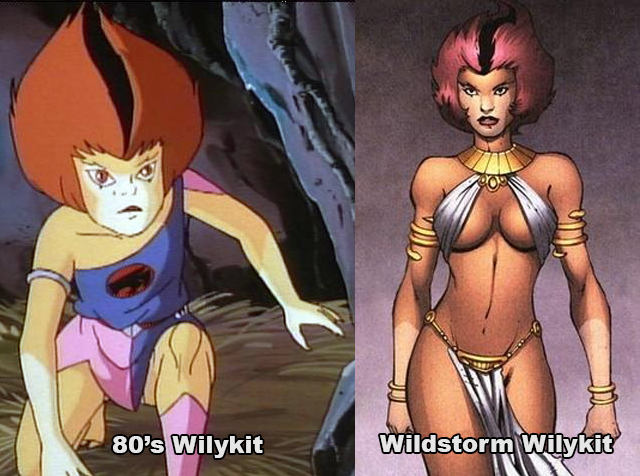
This is really not “a Japan thing”. Anyone who was a Thundercats fan as a child and had the misfortune to pick up a copy of Wildstorm’s comics knows what I’m walking about.
Neither of these are fan productions or porn parodies, these are licensed products of children’s entertainment which apparently felt softcore porn was a suitable addition.
So the arguments suggesting that skimpy female warrior outfits make sense in the context of a character have been around almost as long as the outfits themselves… Not surprisingly, usually the reasoning behind the costume seems to get invented after the costume is already established.
Today I decided to take a look at one of characters famous for supposedly having a ‘reason’ to be half-naked on not one, but at least two levels – Starfire.
The costume(s):
First let’s look at her costume out of context… The original one looks pretty awful, right? Impractically skimpy and, depending on the artist, the torso part ranges from somehow plausible (with a help of double-sided tape, at least), to outright damn impossible. Still, reflective of what superheroes looked like back in the 80s. It’s not like her male colleagues didn’t have their share of silly-by-today’s-standards costumes.
Don’t get me wrong, I’m quite sure the old version would also score some major bingo points, but this is just beyond any possible level of defying physics and common sense. BABD has nothing but utter respect for the cosplayersthat somehowmake this costumeactually work (especially the nipple-pieces).
Oh, and the way she was written upon her first appearance after the DC reboot (the infamous Red Hood & the Outlaws #1) does not help the case. AT ALL.
Which brings us to…
The “context”
As mentioned earlier, Star supposedly has good reasons to dress the way she does. There may be more, but the two most frequently brought up are:
Her alien powers are fueled by exposure to sunlight
Big part of her character is having an agency over her sexuality
We poked the first one a few times already, so let’s get it out of the way quick: SAME FOR SUPERMAN. And if I’m not mistaken, unlike Supes, Starfire is not 100% invincible on top of her strength. I challenge anyone to find us canon evidence that Kryptonians somehow don’t have to be half-naked to absorb sunlight through skin, but Tamaraneans do. Bonus points if you prove that it’s so totally not because the major character from Krypton is a man, while the major character from Tamaran is a woman.
The second one is a ride, as I have a very basic familiarity with the old Titans comics, let alone post-reboot ones, but fortunately I’m not the first person to talk about the subject of Kory’s depiction, so I had some broader frame of reference. I’ll link the sources in the last section of this post.
That said, even if we agree that the revealing costume is expression of Kory being in charge of how sexual she is, the post-reboot comics failed spectacularly at conveying it in a sensible way the old comics did. The batshit redesign, the art that contorts her spine and shoves her boobs and buttin every scene possible, the writing that turned her basically into a living sex doll (an idea so bad that it got subsequently retconned); all of those things were carefully crafted NOT to put some interesting spin on the established character, but to suit the tastes of DC’s supposed target audience: unimaginative, perpetually horny straight boys.
There’s nothing wrong about Starfire being sexy and openly sexual. But how does one turn a character like this:
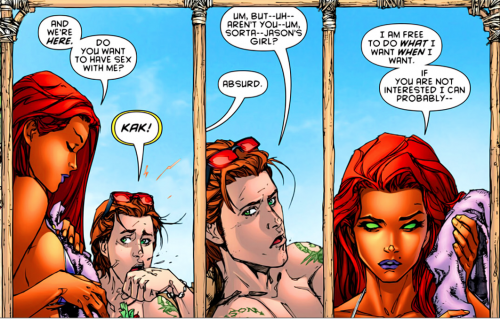
Into someone who joylessly asks people she barely likes for a hookup out of boredom?:
And again, why would any of the above mean she, a superpowered alien warrior princess, should fight crime and villainy in “clothes” that are the superhero equivalent of Scarlet Blade armor? How is her sex life the “context” for her superhero looks? With the old costume at least it can be argued she’s showing off her body, which she’s very comfortable with (canon in comics), with the new one… she only gets cold in her shoulders and feet? And alien fashion defies physics? IDK
Shortpacked! (itswalky) sums up the problem with New 52 depiction of this character (and DC’s bizarre confidence in it) perfectly in this comic strip (rebloggable version here).
Now, to clear you minds, I recommend you guys to check out theliberationofmanfire, a blog dedicated to showing us what Starfire and other comic superheroines would be like if they were redone as equally scantily-clad and sexualized male characters (and yes, that tumblr does precede thehawkeyeinitiative).
Further on the matter:
Linkara’s (@atopfourthwall) video review of Red Hood and the Outlaws #1 – for those who don’t want to be directly subjected the awfulness of that comic (skip to 27th minute if you want to hear only the comments regarding the sexualization controversy)
PS: Funny that Starfire’s official bio seems to not have been updated with anything since the start of New 52 in 2011. Probably because of neglect, but I like to think that official Teen Titans site just prefers to ignore post-reboot Starfire’s design and personality.
edit: Updated link to Linkara’s review, due to Blip being dead and the last link, due to Chez Apocalypse site remaining in the limbo.
Starfire being a very sexual character who comes from a culture that isn’t shy either about sex or nudity? GREAT.
Starfire expressing her views on nudity through a skimpy fetish costume? SURE, WHY NOT.
Said costume being so over-the-top sexualized and physically impossible that it breaks the reader’s immersion? NOT GOOD.
Starfire wearing said costume to fly in the sky and fight villainy (which, mind you, includes super futuristic technology, other superpowered aliens, magic users and demons)? NOPE NOPE NOPE.
So the arguments suggesting that skimpy female warrior outfits make sense in the context of a character have been around almost as long as the outfits themselves… Not surprisingly, usually the reasoning behind the costume seems to get invented after the costume is already established.
Today I decided to take a look at one of characters famous for supposedly having a ‘reason’ to be half-naked on not one, but at least two levels – Starfire.
The costume(s):
First let’s look at her costume out of context… The original one looks pretty awful, right? Impractically skimpy and, depending on the artist, the torso part ranges from somehow plausible (with a help of double-sided tape, at least), to outright damn impossible. Still, reflective of what superheroes looked like back in the 80s. It’s not like her male colleagues didn’t have their share of silly-by-today’s-standards costumes.
Don’t get me wrong, I’m quite sure the old version would also score some major bingo points, but this is just beyond any possible level of defying physics and common sense. BABD has nothing but utter respect for the cosplayersthat somehowmake this costumeactually work (especially the nipple-pieces).
Oh, and the way she was written upon her first appearance after the DC reboot (the infamous Red Hood & the Outlaws #1) does not help the case. AT ALL.
Which brings us to…
The “context”
As mentioned earlier, Star supposedly has good reasons to dress the way she does. There may be more, but the two most frequently brought up are:
Her alien powers are fueled by exposure to sunlight
Big part of her character is having an agency over her sexuality
We poked the first one a few times already, so let’s get it out of the way quick: SAME FOR SUPERMAN. And if I’m not mistaken, unlike Supes, Starfire is not 100% invincible on top of her strength. I challenge anyone to find us canon evidence that Kryptonians somehow don’t have to be half-naked to absorb sunlight through skin, but Tamaraneans do. Bonus points if you prove that it’s so totally not because the major character from Krypton is a man, while the major character from Tamaran is a woman.
The second one is a ride, as I have a very basic familiarity with the old Titans comics, let alone post-reboot ones, but fortunately I’m not the first person to talk about the subject of Kory’s depiction, so I had some broader frame of reference. I’ll link the sources in the last section of this post.
That said, even if we agree that the revealing costume is expression of Kory being in charge of how sexual she is, the post-reboot comics failed spectacularly at conveying it in a sensible way the old comics did. The batshit redesign, the art that contorts her spine and shoves her boobs and buttin every scene possible, the writing that turned her basically into a living sex doll (an idea so bad that it got subsequently retconned); all of those things were carefully crafted NOT to put some interesting spin on the established character, but to suit the tastes of DC’s supposed target audience: unimaginative, perpetually horny straight boys.
There’s nothing wrong about Starfire being sexy and openly sexual. But how does one turn a character like this:
Into someone who joylessly asks people she barely likes for a hookup out of boredom?:
And again, why would any of the above mean she, a superpowered alien warrior princess, should fight crime and villainy in “clothes” that are the superhero equivalent of Scarlet Blade armor? How is her sex life the “context” for her superhero looks? With the old costume at least it can be argued she’s showing off her body, which she’s very comfortable with (canon in comics), with the new one… she only gets cold in her shoulders and feet? And alien fashion defies physics? IDK
Shortpacked! (itswalky) sums up the problem with New 52 depiction of this character (and DC’s bizarre confidence in it) perfectly in this comic strip (rebloggable version here).
Now, to clear you minds, I recommend you guys to check out theliberationofmanfire, a blog dedicated to showing us what Starfire and other comic superheroines would be like if they were redone as equally scantily-clad and sexualized male characters (and yes, that tumblr does precede thehawkeyeinitiative).
Further on the matter:
Linkara’s (@atopfourthwall) video review of Red Hood and the Outlaws #1 – for those who don’t want to be directly subjected the awfulness of that comic (skip to 27th minute if you want to hear only the comments regarding the sexualization controversy)
PS: Funny that Starfire’s official bio seems to not have been updated with anything since the start of New 52 in 2011. Probably because of neglect, but I like to think that official Teen Titans site just prefers to ignore post-reboot Starfire’s design and personality.
edit: Updated link to Linkara’s review, due to Blip being dead and the last link, due to Chez Apocalypse site remaining in the limbo.
Starfire being a very sexual character who comes from a culture that isn’t shy either about sex or nudity? GREAT.
Starfire expressing her views on nudity through a skimpy fetish costume? SURE, WHY NOT.
Said costume being so over-the-top sexualized and physically impossible that it breaks the reader’s immersion? NOT GOOD.
Starfire wearing said costume to fly in the sky and fight villainy (which, mind you, includes super futuristic technology, other superpowered aliens, magic users and demons)? NOPE NOPE NOPE.
The most interesting one of the batch may be the one that’s tried a unique variant of “She was designed in a country where sexualization is cultural!” specifically…
The most interesting one of the batch may be the one that’s tried a unique variant of “She was designed in a country where sexualization is cultural!” specifically…
Sadly it seems the Witcher series didn’t offer the same option to (eventually) play as another character that Metal Gear Solid: The Phantom Pain did – but someone has gone and made a mod for the Witcher 3 that fixes that (kind of).
is flagged as NSFW on NexusMods because it allows you to pick your options for the female models… and since it’s a Witcher game that means nude models and ridiculous outfit options.
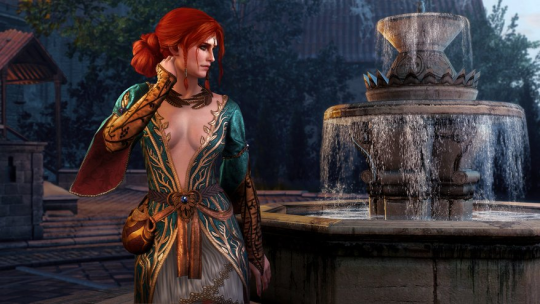
Fortunately the demo video chose to go with the less ridiculous costumes. I mean, there’s a reason a lot of people who liked the game were more than a little disappointed at Triss’ DLC costume:
There is also a mod for playing as Triss in Witcher 2 by the same modder, which is not flagged as NSFW. Unfortunately in both versions, you will still have speak as and otherwise be treated exactly as Geralt – but we’re still grateful to the modding community for filling these gaps as best they can.
Sadly it seems the Witcher series didn’t offer the same option to (eventually) play as another character that Metal Gear Solid: The Phantom Pain did – but someone has gone and made a mod for the Witcher 3 that fixes that (kind of).
is flagged as NSFW on NexusMods because it allows you to pick your options for the female models… and since it’s a Witcher game that means nude models and ridiculous outfit options.
Fortunately the demo video chose to go with the less ridiculous costumes. I mean, there’s a reason a lot of people who liked the game were more than a little disappointed at Triss’ DLC costume:
There is also a mod for playing as Triss in Witcher 2 by the same modder, which is not flagged as NSFW. Unfortunately in both versions, you will still have speak as and otherwise be treated exactly as Geralt – but we’re still grateful to the modding community for filling these gaps as best they can.
What better way to get the year going than with another How Armor Works article by @machiavellianfictionist. The first article is available here and is an excellent resource for anyone who’s ever had a question about mail of any kind.
The full article is below the cut, please be aware that it does contain imagery of combat and injuries.
In this second article of the series I will explain the various types of armor build using organic material, from textiles and leather to wood.
Perhaps the most prominent form of organic armor were padded or quilted garments, usually in the form of a jacket or coat. This padding is achieved by building the garment from several layers of fabric or leather, or by stuffing it with animal hair (usually horse or sheep). This creates a relatively flexible protection which is very cut-resistant, difficult to pierce and capable of absorbing impact. The earliest use of this type of protection can be traced to the Scythians. Ornaments depicting Scythian horsemen in engravings from before the fourth century BCE show padded coats and trousers, but their exact nature is difficult to determine.
The earliest use of padded armor in ancient Europe is even harder to determine. It has been theorized that at least some Roman soldiers may have some type of padding under their mail, called thoracomachus or subarmalis, but there is very little evidence of this. Theoretical reproductions are usually in the shape of a simple vest or tunic that cover the torso, sometimes with strips of padded material hanging over the hips and shoulders. At least these strips alone, called pteruges after a similar feature of Greek hoplite cuirasses, are constantly seen in contemporary depictions. These could have also been separate from any torso protection and made of fabric or leather, either as protection or as an adornment.
The use of padded armor in the early middle ages is a much debated subject, and we have very little to no evidence to support most theories. This general lack of concrete evidence is what gives this period the name of dark ages. However, it is likely than the earliest iterations of the medieval gambeson were created near the end of this period.
The gambeson or aketon is probably the most ubiquitous type of armor in medieval Europe, perhaps even more than the mail hauberk. The classic gambeson takes the form of a long padded coat, open either at the front or the back. Those opened at the front had an overlap on the opening to avoid creating a gap in the protection it provided. It usually had sleeves, but it could be a simple sleeveless garment. If it was meant to be worn by a cavalry soldier, it would have slits on the front and back so it would comfortably drape down the sides of the horse. Some experts believe the first examples may have appeared around the tenth century. These would have probably had a similar pattern as the mail tunics, ending above the knees and with elbow-length sleeves. We do not, however, have any evidence of both padding and mail being worn together at this period, like it was in later times.
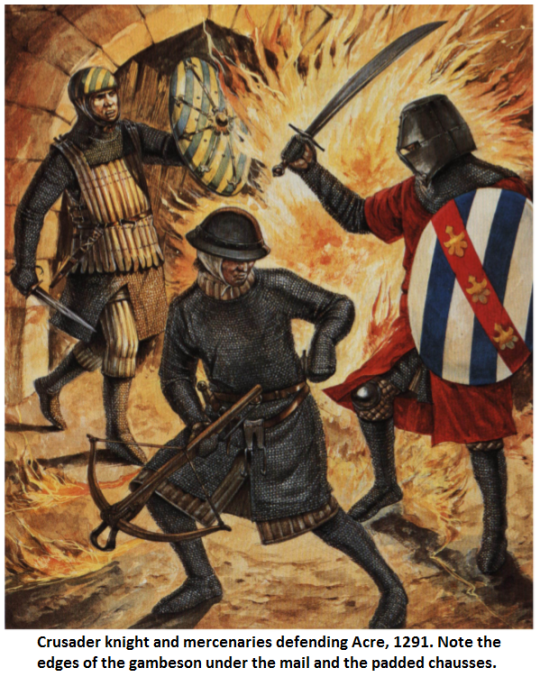
Most people know that mail and padding was worn together, usually the former over the latter, but occasionally the other way around. This practice, however, only became common in the twelfth century, and by the thirteenth century it was virtually universal. On the Bayeux tapestry we can see Norman knights wearing mail with no padding underneath, but a popular theory says they may have had some sort of quilted lining attached to the hauberk. I personally believe the practice may have originated around the time of the first crusade, at the very end of the eleventh century. This combination remained as the pinnacle of European armor through the twelfth century and the first half of the thirteenth century. At the latter third of this timespan a protective garment called the padded chausses emerged, as a quilted protection for the thighs. It’s depicted as being worn over the mail, but it’s possible it was also worn underneath. This piece of armor remained in use through the first half of the fourteenth century, though it wasn’t universally worn.
By the twelfth century a type of armor that combined mail and padding had become popular in the regions dominated by the Islamic sultanates and caliphates. A padded coat called a jubbah contained a simple mail haubergeon between layers of padding. The more commonly mention kazaghand, known in Europe as jazerant, had two mail hauberks of different length contained within different organic materials, very often using rivets to hold the layers in place. The innermost layer was heavy cotton padded with rabbit skin. Then followed a long coat of mail, and over it another layer of cotton with padding. Over this came a shorter coat of mail and finally a silk covering, often heavily decorated. These coats opened on the front, with a similar overlap to front-opened gambesons.
In Japan there was also a combination of mail and fabric garments. Most mail armor was attached to some sort of fabric backing, most commonly in the shape of jackets called kusari katabira, but also in the shape of hoods, gloves, vests and even socks. The mail was often lacquered black to prevent rusting. These garments could have the mail concealed within layers of fabric to hide their function as armor. This style of fabric-backed protection existed since the thirteenth century, but it became extremely popular from the seventeenth to the nineteenth centuries. Even in the rapidly evolving plate harnesses of the fifteenth and sixteenth centuries this fabric-backed mail was used as protection on the parts not covered by plates, or to connect these pieces in a similar way to the plated mail described in the previous article.
Back in Europe, as armor evolved gambesons became more elaborate. Fourteenth and fifteenth century gambesons were usually slightly shorter and had a tighter fit than previous models, and they were most commonly open at the front, closed with buttons or buckles. The cut of the sleeves was done very deep into the torso, so the wearer could move their arms freely without having to pull on the rest of the garment. They could also have simple decorative features, like dagged ends at the bottom or a dyed outer layer. When plate leg armor came into use, it was often secured to the inside of the gambeson to keep from it resting its entire weight on the legs. A tight padded or leather waistband could also be used for this purpose. Near the end of the fourteenth century the gambeson had become very narrow at the waist, to better accommodate the new style of torso protection, the globular breastplate.
While mail hauberks over long gambesons were no longer in use by the heavily armored soldiers of the fifteenth century, this combination remained in use by lighter troops through the rest of the medieval period, and even the beginning of the Renaissance. Some soldiers like the Irish gallowglass wore gambesons alone or under a mail hauberk well into the latter half of the sixteenth century.
By the middle of the fifteenth century the arming jack or doublet had been fully developed, a padded garment derivate from the gambeson designed to secure the full plate harness onto the soldier’s body. The armor had small holes through which it could be laced or pointed to the jack, and the leg armor was hanged either directly from the bottom of it or from a separate waistband secured above the hips. Very often strips or sleeves of mail called voiders were attached to this garment to cover the gaps in the plate harness, usually on the armpits and the inside of the elbows. By the end of the sixteenth century it was common to use a padded doublet following the fashions of civilian clothing as protection for the practice of fencing.
Leather was also a very common element of armor. The soft flexible leather most people are familiar with was very often used as an element of armor, and in general in the medieval world it was used to make clothes, lacing, straps and the like. However, when we talk about leather being used as the main protective material, we’re exclusively talking about rawhide. Rawhide is the untanned skin of an animal after it’s been stripped of hair and fat, and then stretched and let try. It’s a hard material that retains some flexibility and can even be slightly transparent if thin enough.
By itself rawhide has some level of resistance to cutting and piercing, and when used in layers it can be very effective at absorbing impact. While they’re not armor, it’s worth mentioning that European wooden shields of all sizes from the migration era onwards have frequently been covered with one or more layers of rawhide for these reasons. At least the rim alone would often be covered with strip of rawhide to prevent it from being cut and split. In other parts of the world shields could be made of several layers of rawhide alone, sometimes with a simple wooden structure to give it shape and rigidity, like the tall shields used by many African tribal warriors. In Sudan and Somalia a particular type of small round shield made from rhino hide could allegedly even stop musket balls.
The use of leather to make body armor goes all the way to antiquity. Its earliest iteration was probably in the shape of scale and lamellar armor. The leather would be layered, shaped and secured in the same manner as metal scales or lames, sometimes in combination with these. This form of defense would be used for many centuries, perhaps most famously by the Mongol warriors of the thirteenth century. The actual structure and function of scale and lamellar armor will be further explained in a future article.
Another use of rawhide was to make boiled leather. This term has been used to refer to many types of fantasy armor, most of them impractical and restrictive garments. Real medieval boiled leather is a very mysterious material, but we do have some historical evidence that was been further studied with the use of experimental archeology. The most plausible theory for the manufacture and use of boiled leather is to cover the rawhide in wax, secure it onto a wooden former and them bake it in an oven until it becomes hard and rigid. Reproductions of this type have a similar feel to modern police riot armor.
The most common form of boiled leather armor was most likely schinbalds, curved plates designed to protect the shins. These appeared in the first half of the thirteenth century, and were usually made of steel or iron, but boiled leather could be used as a more economical alternative. Simple vambraces to protect the forearm are also a very plausible form of defense. The use of boiled leather to protect the torso is much more questionable, since so far there is very few evidence for it, at least in Europe.
In Japan there are also several mentions of boiled leather used to make armor, though I’ve had some trouble finding concrete research material. What I’ve been able to gather comes from the fifteenth century onwards. Some armor worn by relatively poor ashigaru (infantry soldiers) may have been made of boiled leather covered with layers of lacquer. Other pieces of the foot soldier’s armor may have been constructed in the same manner, though most ashigaru were generally less armored than the samurai, who would invariably be clad in iron or steel. The broad conical hat called jingasa could have been made of boiled leather, though iron was the preferred material since it allowed the soldier to use it as a cooking implement.
It’s worth keeping in mind that given the choice between wearing a piece of armor made out of metal or leather, metal is almost always preferable. The only advantage leather gives is reduced manufacturing cost, and perhaps more comfort in certain climates.
In the European Renaissance, near the end of the sixteenth century, a type of armor known as a buff coat appeared. This had the shape of a knee-length coat, sleeveless or otherwise, usually with a broad skirt and a raised collar to protect the neck. It was made with a few layers of rawhide repeatedly treated with cod oil to make them waterproof and to prevent them from rotting. This treatment would give them their characteristic pale yellow color. The edges were sewn together very tightly without an overlap, to prevent the stitching from wearing down. Sometimes a coat could in fact be two coats of different sizes sewn one over the other, to provide better protection in some areas and more flexibility in others. The buff coat could be decorated with ornamental cuts and stitching, or have a fabric lining for comfort, but generally maintained a simple and functional appearance.
The buff coat was of little use against firearms of any kind, but could provide vital protection against swords and pikes, the most common melee weapons of the time. Given its versatility and the complexity of its manufacturing process, even a buff coat of unremarkable quality could cost as much as a breastplate, and the finer models could cost many times more. Buff coats were usually worn underneath a breastplate, though less wealthy soldiers could of course choose to wear it by itself.
Leather and fabric was also used to armor horses. Boiled leather was used to make chamfrons (armor for the horse’s head), sometimes with metallic edges or reinforcements, from the time of the Roman Empire up to the high middle ages. Since the thirteenth century some horses were armored in mail, and some sort of padding or lining was certainly used underneath. We have literary mentions of thick felt used to protect horses, particularly in the Middle East and the north of Africa. There’s also a rising theory amongst cavalry enthusiasts that the heavy mantles used to cover horses, which are widely believed to be purely decorative, may have helped catch arrows that would otherwise strike the troops riding behind the covered horse, but up to this day it’s merely a hypothesis.
We should also keep in mind that, while it may not always be the main protective material, fabric and leather were almost always used in the construction of armor. A metallic lamellar cuirass would need lacing to keep it together. Scale armor needs a backing to have an actual shape. The ventails of the hooded mail hauberk would need lining and lacing to be closed over the face of the wearer (though metallic hooks would also serve). The coat of plates and its later derivatives, the early breastplate and the brigandine, would need a sturdy organic facing to give the plates structure. Even the most elaborate sets of full plate harness relied on a combination of leather straps and lacing to assemble and attach to the wearer.
To finish with leather and fabric, I want to mention a very controversial type of armor. It’s often known as hoplite cuirass, associated with the Greek warriors of antiquity, though variations of it were also used by virtually all the cultures surrounding the Mediterranean. Its earliest appearance is in Homer’s Iliad (estimated between the thirteenth and twelfth centuries BCE) and it remained in use well into the Hellenistic period (starting at the death of Alexander the Great in 326 BCE). The shape is very well known, a hexagonal plate covering the chest from collarbone to navel, connected to a similarly shaped back plate by two rectangular plates at the sides, with pteruges hanging down to the hips. The armor is held in place with the help of a yoke-like piece attached to the back plate which folds forward to cover the shoulders and is then laced to the front. The armor is closed at the left side of the warrior with two lacing points. The whole armor is usually decorated, the edges are painted and the front in particular often had very elaborate designs and metal ornaments.
The controversy lies in the materials and construction of the cuirass. People argue it could have been made with layers of leather, linen or a combination of both. Those who advocate for the linen cuirasses often call this armor linothorax. These is very little evidence to back any of these claims, but I personally believe using leather as the primary material would make more sense, mostly because it would be cheaper. Some cuirasses may have had a thin sheet of metal, either bronze or iron, between the layers of the front plate. These cuirasses were often reinforced with bronze scales. Some were completely covered in them, but they were most commonly used to cover the sides or the waist of the warrior, where experimental archeologists believe they were most likely to be attacked. There’s also some discussion on whether the cuirass was made in a single piece or if it was different pieces connected with hinges and wire pins. Of course, there’s always the possibility that different types of these cuirasses with different construction methods existed at some point in time.
To finish this article, I would like to talk about the armor worn by the native people of the Americas. A common misconception of these people is that of peaceful tribal folk with very primitive and minimal ways of combat. The reality is that when the Conquistadors arrived at the American mainland, they found powerful empires with very well-organized militaries. Some of the most powerful North American tribes had joined together to form the Iroquois Confederacy.
These native soldiers generally worn little in ways of body armor. The most likely reason for this is a preference for comfort in inclement weather. This is an easy conclusion, but I also believe there must have been a preference for light troops suitable for a very mobile type of warfare. There’s also the fact that the metals which made it possible for eastern civilizations to develop rigid armor were very scarce at that time, and were mainly used to make weapons and tools. The troops that could be considered heavy generally relegated the protection of their bodies to their shields, while lighter skirmishers often only carried their main weapons.
The most common form of armor in central and South America came in the shape of a simple quilted vest, very similar to a sleeveless gambeson. This could be of varied length, with the shorter ones stopping above the hips and the longest ones being about mid-thigh length. These could be opened at the front or pulled over the head. Some soldiers may wear richly decorated garments over these armored vests, most famously Mesoamerican warriors who covered themselves in full-body garments designed to look like a beast’s fur or a bird’s feathers. Organic materials were also used to make simple helmets in the form of thick caps.
Wood was normally used to make helmets. Aztec warriors carved hardwood into open-faced helmets shaped and painted like animal heads, to match with the previously mentioned decorated outfits. The Tinglit of the Pacific Northwest Coast, despite their extensive use of firearms, were famous for their use of wooden armor. They made wooden helmets, which came in two pieces, often carved and painted to match. The upper piece would protect the top of the head and the lower piece would surround the face and neck. The wearer could see through the gap between these pieces. They also had wooden body armor in the shape of narrow wooden strips arranged vertically and laced together. This protection was wrapped around the torso and protected it from collarbone to crotch. Most examples of these garments come from the late eighteenth and early nineteenth centuries, but it’s possible that it existed before this time.
What better way to get the year going than with another How Armor Works article by @machiavellianfictionist. The first article is available here and is an excellent resource for anyone who’s ever had a question about mail of any kind.
The full article is below the cut, please be aware that it does contain imagery of combat and injuries.
In this second article of the series I will explain the various types of armor build using organic material, from textiles and leather to wood.
Perhaps the most prominent form of organic armor were padded or quilted garments, usually in the form of a jacket or coat. This padding is achieved by building the garment from several layers of fabric or leather, or by stuffing it with animal hair (usually horse or sheep). This creates a relatively flexible protection which is very cut-resistant, difficult to pierce and capable of absorbing impact. The earliest use of this type of protection can be traced to the Scythians. Ornaments depicting Scythian horsemen in engravings from before the fourth century BCE show padded coats and trousers, but their exact nature is difficult to determine.
The earliest use of padded armor in ancient Europe is even harder to determine. It has been theorized that at least some Roman soldiers may have some type of padding under their mail, called thoracomachus or subarmalis, but there is very little evidence of this. Theoretical reproductions are usually in the shape of a simple vest or tunic that cover the torso, sometimes with strips of padded material hanging over the hips and shoulders. At least these strips alone, called pteruges after a similar feature of Greek hoplite cuirasses, are constantly seen in contemporary depictions. These could have also been separate from any torso protection and made of fabric or leather, either as protection or as an adornment.
The use of padded armor in the early middle ages is a much debated subject, and we have very little to no evidence to support most theories. This general lack of concrete evidence is what gives this period the name of dark ages. However, it is likely than the earliest iterations of the medieval gambeson were created near the end of this period.
The gambeson or aketon is probably the most ubiquitous type of armor in medieval Europe, perhaps even more than the mail hauberk. The classic gambeson takes the form of a long padded coat, open either at the front or the back. Those opened at the front had an overlap on the opening to avoid creating a gap in the protection it provided. It usually had sleeves, but it could be a simple sleeveless garment. If it was meant to be worn by a cavalry soldier, it would have slits on the front and back so it would comfortably drape down the sides of the horse. Some experts believe the first examples may have appeared around the tenth century. These would have probably had a similar pattern as the mail tunics, ending above the knees and with elbow-length sleeves. We do not, however, have any evidence of both padding and mail being worn together at this period, like it was in later times.
Most people know that mail and padding was worn together, usually the former over the latter, but occasionally the other way around. This practice, however, only became common in the twelfth century, and by the thirteenth century it was virtually universal. On the Bayeux tapestry we can see Norman knights wearing mail with no padding underneath, but a popular theory says they may have had some sort of quilted lining attached to the hauberk. I personally believe the practice may have originated around the time of the first crusade, at the very end of the eleventh century. This combination remained as the pinnacle of European armor through the twelfth century and the first half of the thirteenth century. At the latter third of this timespan a protective garment called the padded chausses emerged, as a quilted protection for the thighs. It’s depicted as being worn over the mail, but it’s possible it was also worn underneath. This piece of armor remained in use through the first half of the fourteenth century, though it wasn’t universally worn.
By the twelfth century a type of armor that combined mail and padding had become popular in the regions dominated by the Islamic sultanates and caliphates. A padded coat called a jubbah contained a simple mail haubergeon between layers of padding. The more commonly mention kazaghand, known in Europe as jazerant, had two mail hauberks of different length contained within different organic materials, very often using rivets to hold the layers in place. The innermost layer was heavy cotton padded with rabbit skin. Then followed a long coat of mail, and over it another layer of cotton with padding. Over this came a shorter coat of mail and finally a silk covering, often heavily decorated. These coats opened on the front, with a similar overlap to front-opened gambesons.
In Japan there was also a combination of mail and fabric garments. Most mail armor was attached to some sort of fabric backing, most commonly in the shape of jackets called kusari katabira, but also in the shape of hoods, gloves, vests and even socks. The mail was often lacquered black to prevent rusting. These garments could have the mail concealed within layers of fabric to hide their function as armor. This style of fabric-backed protection existed since the thirteenth century, but it became extremely popular from the seventeenth to the nineteenth centuries. Even in the rapidly evolving plate harnesses of the fifteenth and sixteenth centuries this fabric-backed mail was used as protection on the parts not covered by plates, or to connect these pieces in a similar way to the plated mail described in the previous article.
Back in Europe, as armor evolved gambesons became more elaborate. Fourteenth and fifteenth century gambesons were usually slightly shorter and had a tighter fit than previous models, and they were most commonly open at the front, closed with buttons or buckles. The cut of the sleeves was done very deep into the torso, so the wearer could move their arms freely without having to pull on the rest of the garment. They could also have simple decorative features, like dagged ends at the bottom or a dyed outer layer. When plate leg armor came into use, it was often secured to the inside of the gambeson to keep from it resting its entire weight on the legs. A tight padded or leather waistband could also be used for this purpose. Near the end of the fourteenth century the gambeson had become very narrow at the waist, to better accommodate the new style of torso protection, the globular breastplate.
While mail hauberks over long gambesons were no longer in use by the heavily armored soldiers of the fifteenth century, this combination remained in use by lighter troops through the rest of the medieval period, and even the beginning of the Renaissance. Some soldiers like the Irish gallowglass wore gambesons alone or under a mail hauberk well into the latter half of the sixteenth century.
By the middle of the fifteenth century the arming jack or doublet had been fully developed, a padded garment derivate from the gambeson designed to secure the full plate harness onto the soldier’s body. The armor had small holes through which it could be laced or pointed to the jack, and the leg armor was hanged either directly from the bottom of it or from a separate waistband secured above the hips. Very often strips or sleeves of mail called voiders were attached to this garment to cover the gaps in the plate harness, usually on the armpits and the inside of the elbows. By the end of the sixteenth century it was common to use a padded doublet following the fashions of civilian clothing as protection for the practice of fencing.
Leather was also a very common element of armor. The soft flexible leather most people are familiar with was very often used as an element of armor, and in general in the medieval world it was used to make clothes, lacing, straps and the like. However, when we talk about leather being used as the main protective material, we’re exclusively talking about rawhide. Rawhide is the untanned skin of an animal after it’s been stripped of hair and fat, and then stretched and let try. It’s a hard material that retains some flexibility and can even be slightly transparent if thin enough.
By itself rawhide has some level of resistance to cutting and piercing, and when used in layers it can be very effective at absorbing impact. While they’re not armor, it’s worth mentioning that European wooden shields of all sizes from the migration era onwards have frequently been covered with one or more layers of rawhide for these reasons. At least the rim alone would often be covered with strip of rawhide to prevent it from being cut and split. In other parts of the world shields could be made of several layers of rawhide alone, sometimes with a simple wooden structure to give it shape and rigidity, like the tall shields used by many African tribal warriors. In Sudan and Somalia a particular type of small round shield made from rhino hide could allegedly even stop musket balls.
The use of leather to make body armor goes all the way to antiquity. Its earliest iteration was probably in the shape of scale and lamellar armor. The leather would be layered, shaped and secured in the same manner as metal scales or lames, sometimes in combination with these. This form of defense would be used for many centuries, perhaps most famously by the Mongol warriors of the thirteenth century. The actual structure and function of scale and lamellar armor will be further explained in a future article.
Another use of rawhide was to make boiled leather. This term has been used to refer to many types of fantasy armor, most of them impractical and restrictive garments. Real medieval boiled leather is a very mysterious material, but we do have some historical evidence that was been further studied with the use of experimental archeology. The most plausible theory for the manufacture and use of boiled leather is to cover the rawhide in wax, secure it onto a wooden former and them bake it in an oven until it becomes hard and rigid. Reproductions of this type have a similar feel to modern police riot armor.
The most common form of boiled leather armor was most likely schinbalds, curved plates designed to protect the shins. These appeared in the first half of the thirteenth century, and were usually made of steel or iron, but boiled leather could be used as a more economical alternative. Simple vambraces to protect the forearm are also a very plausible form of defense. The use of boiled leather to protect the torso is much more questionable, since so far there is very few evidence for it, at least in Europe.
In Japan there are also several mentions of boiled leather used to make armor, though I’ve had some trouble finding concrete research material. What I’ve been able to gather comes from the fifteenth century onwards. Some armor worn by relatively poor ashigaru (infantry soldiers) may have been made of boiled leather covered with layers of lacquer. Other pieces of the foot soldier’s armor may have been constructed in the same manner, though most ashigaru were generally less armored than the samurai, who would invariably be clad in iron or steel. The broad conical hat called jingasa could have been made of boiled leather, though iron was the preferred material since it allowed the soldier to use it as a cooking implement.
It’s worth keeping in mind that given the choice between wearing a piece of armor made out of metal or leather, metal is almost always preferable. The only advantage leather gives is reduced manufacturing cost, and perhaps more comfort in certain climates.
In the European Renaissance, near the end of the sixteenth century, a type of armor known as a buff coat appeared. This had the shape of a knee-length coat, sleeveless or otherwise, usually with a broad skirt and a raised collar to protect the neck. It was made with a few layers of rawhide repeatedly treated with cod oil to make them waterproof and to prevent them from rotting. This treatment would give them their characteristic pale yellow color. The edges were sewn together very tightly without an overlap, to prevent the stitching from wearing down. Sometimes a coat could in fact be two coats of different sizes sewn one over the other, to provide better protection in some areas and more flexibility in others. The buff coat could be decorated with ornamental cuts and stitching, or have a fabric lining for comfort, but generally maintained a simple and functional appearance.
The buff coat was of little use against firearms of any kind, but could provide vital protection against swords and pikes, the most common melee weapons of the time. Given its versatility and the complexity of its manufacturing process, even a buff coat of unremarkable quality could cost as much as a breastplate, and the finer models could cost many times more. Buff coats were usually worn underneath a breastplate, though less wealthy soldiers could of course choose to wear it by itself.
Leather and fabric was also used to armor horses. Boiled leather was used to make chamfrons (armor for the horse’s head), sometimes with metallic edges or reinforcements, from the time of the Roman Empire up to the high middle ages. Since the thirteenth century some horses were armored in mail, and some sort of padding or lining was certainly used underneath. We have literary mentions of thick felt used to protect horses, particularly in the Middle East and the north of Africa. There’s also a rising theory amongst cavalry enthusiasts that the heavy mantles used to cover horses, which are widely believed to be purely decorative, may have helped catch arrows that would otherwise strike the troops riding behind the covered horse, but up to this day it’s merely a hypothesis.
We should also keep in mind that, while it may not always be the main protective material, fabric and leather were almost always used in the construction of armor. A metallic lamellar cuirass would need lacing to keep it together. Scale armor needs a backing to have an actual shape. The ventails of the hooded mail hauberk would need lining and lacing to be closed over the face of the wearer (though metallic hooks would also serve). The coat of plates and its later derivatives, the early breastplate and the brigandine, would need a sturdy organic facing to give the plates structure. Even the most elaborate sets of full plate harness relied on a combination of leather straps and lacing to assemble and attach to the wearer.
To finish with leather and fabric, I want to mention a very controversial type of armor. It’s often known as hoplite cuirass, associated with the Greek warriors of antiquity, though variations of it were also used by virtually all the cultures surrounding the Mediterranean. Its earliest appearance is in Homer’s Iliad (estimated between the thirteenth and twelfth centuries BCE) and it remained in use well into the Hellenistic period (starting at the death of Alexander the Great in 326 BCE). The shape is very well known, a hexagonal plate covering the chest from collarbone to navel, connected to a similarly shaped back plate by two rectangular plates at the sides, with pteruges hanging down to the hips. The armor is held in place with the help of a yoke-like piece attached to the back plate which folds forward to cover the shoulders and is then laced to the front. The armor is closed at the left side of the warrior with two lacing points. The whole armor is usually decorated, the edges are painted and the front in particular often had very elaborate designs and metal ornaments.
The controversy lies in the materials and construction of the cuirass. People argue it could have been made with layers of leather, linen or a combination of both. Those who advocate for the linen cuirasses often call this armor linothorax. These is very little evidence to back any of these claims, but I personally believe using leather as the primary material would make more sense, mostly because it would be cheaper. Some cuirasses may have had a thin sheet of metal, either bronze or iron, between the layers of the front plate. These cuirasses were often reinforced with bronze scales. Some were completely covered in them, but they were most commonly used to cover the sides or the waist of the warrior, where experimental archeologists believe they were most likely to be attacked. There’s also some discussion on whether the cuirass was made in a single piece or if it was different pieces connected with hinges and wire pins. Of course, there’s always the possibility that different types of these cuirasses with different construction methods existed at some point in time.
To finish this article, I would like to talk about the armor worn by the native people of the Americas. A common misconception of these people is that of peaceful tribal folk with very primitive and minimal ways of combat. The reality is that when the Conquistadors arrived at the American mainland, they found powerful empires with very well-organized militaries. Some of the most powerful North American tribes had joined together to form the Iroquois Confederacy.
These native soldiers generally worn little in ways of body armor. The most likely reason for this is a preference for comfort in inclement weather. This is an easy conclusion, but I also believe there must have been a preference for light troops suitable for a very mobile type of warfare. There’s also the fact that the metals which made it possible for eastern civilizations to develop rigid armor were very scarce at that time, and were mainly used to make weapons and tools. The troops that could be considered heavy generally relegated the protection of their bodies to their shields, while lighter skirmishers often only carried their main weapons.
The most common form of armor in central and South America came in the shape of a simple quilted vest, very similar to a sleeveless gambeson. This could be of varied length, with the shorter ones stopping above the hips and the longest ones being about mid-thigh length. These could be opened at the front or pulled over the head. Some soldiers may wear richly decorated garments over these armored vests, most famously Mesoamerican warriors who covered themselves in full-body garments designed to look like a beast’s fur or a bird’s feathers. Organic materials were also used to make simple helmets in the form of thick caps.
Wood was normally used to make helmets. Aztec warriors carved hardwood into open-faced helmets shaped and painted like animal heads, to match with the previously mentioned decorated outfits. The Tinglit of the Pacific Northwest Coast, despite their extensive use of firearms, were famous for their use of wooden armor. They made wooden helmets, which came in two pieces, often carved and painted to match. The upper piece would protect the top of the head and the lower piece would surround the face and neck. The wearer could see through the gap between these pieces. They also had wooden body armor in the shape of narrow wooden strips arranged vertically and laced together. This protection was wrapped around the torso and protected it from collarbone to crotch. Most examples of these garments come from the late eighteenth and early nineteenth centuries, but it’s possible that it existed before this time.
What better way to get the year going than with another How Armor Works article by @machiavellianfictionist. The first article is available here and is an excellent resource for anyone who’s ever had a question about mail of any kind.
The full article is below the cut, please be aware that it does contain imagery of combat and injuries.
In this second article of the series I will explain the various types of armor build using organic material, from textiles and leather to wood.
Perhaps the most prominent form of organic armor were padded or quilted garments, usually in the form of a jacket or coat. This padding is achieved by building the garment from several layers of fabric or leather, or by stuffing it with animal hair (usually horse or sheep). This creates a relatively flexible protection which is very cut-resistant, difficult to pierce and capable of absorbing impact. The earliest use of this type of protection can be traced to the Scythians. Ornaments depicting Scythian horsemen in engravings from before the fourth century BCE show padded coats and trousers, but their exact nature is difficult to determine.
The earliest use of padded armor in ancient Europe is even harder to determine. It has been theorized that at least some Roman soldiers may have some type of padding under their mail, called thoracomachus or subarmalis, but there is very little evidence of this. Theoretical reproductions are usually in the shape of a simple vest or tunic that cover the torso, sometimes with strips of padded material hanging over the hips and shoulders. At least these strips alone, called pteruges after a similar feature of Greek hoplite cuirasses, are constantly seen in contemporary depictions. These could have also been separate from any torso protection and made of fabric or leather, either as protection or as an adornment.
The use of padded armor in the early middle ages is a much debated subject, and we have very little to no evidence to support most theories. This general lack of concrete evidence is what gives this period the name of dark ages. However, it is likely than the earliest iterations of the medieval gambeson were created near the end of this period.
The gambeson or aketon is probably the most ubiquitous type of armor in medieval Europe, perhaps even more than the mail hauberk. The classic gambeson takes the form of a long padded coat, open either at the front or the back. Those opened at the front had an overlap on the opening to avoid creating a gap in the protection it provided. It usually had sleeves, but it could be a simple sleeveless garment. If it was meant to be worn by a cavalry soldier, it would have slits on the front and back so it would comfortably drape down the sides of the horse. Some experts believe the first examples may have appeared around the tenth century. These would have probably had a similar pattern as the mail tunics, ending above the knees and with elbow-length sleeves. We do not, however, have any evidence of both padding and mail being worn together at this period, like it was in later times.
Most people know that mail and padding was worn together, usually the former over the latter, but occasionally the other way around. This practice, however, only became common in the twelfth century, and by the thirteenth century it was virtually universal. On the Bayeux tapestry we can see Norman knights wearing mail with no padding underneath, but a popular theory says they may have had some sort of quilted lining attached to the hauberk. I personally believe the practice may have originated around the time of the first crusade, at the very end of the eleventh century. This combination remained as the pinnacle of European armor through the twelfth century and the first half of the thirteenth century. At the latter third of this timespan a protective garment called the padded chausses emerged, as a quilted protection for the thighs. It’s depicted as being worn over the mail, but it’s possible it was also worn underneath. This piece of armor remained in use through the first half of the fourteenth century, though it wasn’t universally worn.
By the twelfth century a type of armor that combined mail and padding had become popular in the regions dominated by the Islamic sultanates and caliphates. A padded coat called a jubbah contained a simple mail haubergeon between layers of padding. The more commonly mention kazaghand, known in Europe as jazerant, had two mail hauberks of different length contained within different organic materials, very often using rivets to hold the layers in place. The innermost layer was heavy cotton padded with rabbit skin. Then followed a long coat of mail, and over it another layer of cotton with padding. Over this came a shorter coat of mail and finally a silk covering, often heavily decorated. These coats opened on the front, with a similar overlap to front-opened gambesons.
In Japan there was also a combination of mail and fabric garments. Most mail armor was attached to some sort of fabric backing, most commonly in the shape of jackets called kusari katabira, but also in the shape of hoods, gloves, vests and even socks. The mail was often lacquered black to prevent rusting. These garments could have the mail concealed within layers of fabric to hide their function as armor. This style of fabric-backed protection existed since the thirteenth century, but it became extremely popular from the seventeenth to the nineteenth centuries. Even in the rapidly evolving plate harnesses of the fifteenth and sixteenth centuries this fabric-backed mail was used as protection on the parts not covered by plates, or to connect these pieces in a similar way to the plated mail described in the previous article.
Back in Europe, as armor evolved gambesons became more elaborate. Fourteenth and fifteenth century gambesons were usually slightly shorter and had a tighter fit than previous models, and they were most commonly open at the front, closed with buttons or buckles. The cut of the sleeves was done very deep into the torso, so the wearer could move their arms freely without having to pull on the rest of the garment. They could also have simple decorative features, like dagged ends at the bottom or a dyed outer layer. When plate leg armor came into use, it was often secured to the inside of the gambeson to keep from it resting its entire weight on the legs. A tight padded or leather waistband could also be used for this purpose. Near the end of the fourteenth century the gambeson had become very narrow at the waist, to better accommodate the new style of torso protection, the globular breastplate.
While mail hauberks over long gambesons were no longer in use by the heavily armored soldiers of the fifteenth century, this combination remained in use by lighter troops through the rest of the medieval period, and even the beginning of the Renaissance. Some soldiers like the Irish gallowglass wore gambesons alone or under a mail hauberk well into the latter half of the sixteenth century.
By the middle of the fifteenth century the arming jack or doublet had been fully developed, a padded garment derivate from the gambeson designed to secure the full plate harness onto the soldier’s body. The armor had small holes through which it could be laced or pointed to the jack, and the leg armor was hanged either directly from the bottom of it or from a separate waistband secured above the hips. Very often strips or sleeves of mail called voiders were attached to this garment to cover the gaps in the plate harness, usually on the armpits and the inside of the elbows. By the end of the sixteenth century it was common to use a padded doublet following the fashions of civilian clothing as protection for the practice of fencing.
Leather was also a very common element of armor. The soft flexible leather most people are familiar with was very often used as an element of armor, and in general in the medieval world it was used to make clothes, lacing, straps and the like. However, when we talk about leather being used as the main protective material, we’re exclusively talking about rawhide. Rawhide is the untanned skin of an animal after it’s been stripped of hair and fat, and then stretched and let try. It’s a hard material that retains some flexibility and can even be slightly transparent if thin enough.
By itself rawhide has some level of resistance to cutting and piercing, and when used in layers it can be very effective at absorbing impact. While they’re not armor, it’s worth mentioning that European wooden shields of all sizes from the migration era onwards have frequently been covered with one or more layers of rawhide for these reasons. At least the rim alone would often be covered with strip of rawhide to prevent it from being cut and split. In other parts of the world shields could be made of several layers of rawhide alone, sometimes with a simple wooden structure to give it shape and rigidity, like the tall shields used by many African tribal warriors. In Sudan and Somalia a particular type of small round shield made from rhino hide could allegedly even stop musket balls.
The use of leather to make body armor goes all the way to antiquity. Its earliest iteration was probably in the shape of scale and lamellar armor. The leather would be layered, shaped and secured in the same manner as metal scales or lames, sometimes in combination with these. This form of defense would be used for many centuries, perhaps most famously by the Mongol warriors of the thirteenth century. The actual structure and function of scale and lamellar armor will be further explained in a future article.
Another use of rawhide was to make boiled leather. This term has been used to refer to many types of fantasy armor, most of them impractical and restrictive garments. Real medieval boiled leather is a very mysterious material, but we do have some historical evidence that was been further studied with the use of experimental archeology. The most plausible theory for the manufacture and use of boiled leather is to cover the rawhide in wax, secure it onto a wooden former and them bake it in an oven until it becomes hard and rigid. Reproductions of this type have a similar feel to modern police riot armor.
The most common form of boiled leather armor was most likely schinbalds, curved plates designed to protect the shins. These appeared in the first half of the thirteenth century, and were usually made of steel or iron, but boiled leather could be used as a more economical alternative. Simple vambraces to protect the forearm are also a very plausible form of defense. The use of boiled leather to protect the torso is much more questionable, since so far there is very few evidence for it, at least in Europe.
In Japan there are also several mentions of boiled leather used to make armor, though I’ve had some trouble finding concrete research material. What I’ve been able to gather comes from the fifteenth century onwards. Some armor worn by relatively poor ashigaru (infantry soldiers) may have been made of boiled leather covered with layers of lacquer. Other pieces of the foot soldier’s armor may have been constructed in the same manner, though most ashigaru were generally less armored than the samurai, who would invariably be clad in iron or steel. The broad conical hat called jingasa could have been made of boiled leather, though iron was the preferred material since it allowed the soldier to use it as a cooking implement.
It’s worth keeping in mind that given the choice between wearing a piece of armor made out of metal or leather, metal is almost always preferable. The only advantage leather gives is reduced manufacturing cost, and perhaps more comfort in certain climates.
In the European Renaissance, near the end of the sixteenth century, a type of armor known as a buff coat appeared. This had the shape of a knee-length coat, sleeveless or otherwise, usually with a broad skirt and a raised collar to protect the neck. It was made with a few layers of rawhide repeatedly treated with cod oil to make them waterproof and to prevent them from rotting. This treatment would give them their characteristic pale yellow color. The edges were sewn together very tightly without an overlap, to prevent the stitching from wearing down. Sometimes a coat could in fact be two coats of different sizes sewn one over the other, to provide better protection in some areas and more flexibility in others. The buff coat could be decorated with ornamental cuts and stitching, or have a fabric lining for comfort, but generally maintained a simple and functional appearance.
The buff coat was of little use against firearms of any kind, but could provide vital protection against swords and pikes, the most common melee weapons of the time. Given its versatility and the complexity of its manufacturing process, even a buff coat of unremarkable quality could cost as much as a breastplate, and the finer models could cost many times more. Buff coats were usually worn underneath a breastplate, though less wealthy soldiers could of course choose to wear it by itself.
Leather and fabric was also used to armor horses. Boiled leather was used to make chamfrons (armor for the horse’s head), sometimes with metallic edges or reinforcements, from the time of the Roman Empire up to the high middle ages. Since the thirteenth century some horses were armored in mail, and some sort of padding or lining was certainly used underneath. We have literary mentions of thick felt used to protect horses, particularly in the Middle East and the north of Africa. There’s also a rising theory amongst cavalry enthusiasts that the heavy mantles used to cover horses, which are widely believed to be purely decorative, may have helped catch arrows that would otherwise strike the troops riding behind the covered horse, but up to this day it’s merely a hypothesis.
We should also keep in mind that, while it may not always be the main protective material, fabric and leather were almost always used in the construction of armor. A metallic lamellar cuirass would need lacing to keep it together. Scale armor needs a backing to have an actual shape. The ventails of the hooded mail hauberk would need lining and lacing to be closed over the face of the wearer (though metallic hooks would also serve). The coat of plates and its later derivatives, the early breastplate and the brigandine, would need a sturdy organic facing to give the plates structure. Even the most elaborate sets of full plate harness relied on a combination of leather straps and lacing to assemble and attach to the wearer.
To finish with leather and fabric, I want to mention a very controversial type of armor. It’s often known as hoplite cuirass, associated with the Greek warriors of antiquity, though variations of it were also used by virtually all the cultures surrounding the Mediterranean. Its earliest appearance is in Homer’s Iliad (estimated between the thirteenth and twelfth centuries BCE) and it remained in use well into the Hellenistic period (starting at the death of Alexander the Great in 326 BCE). The shape is very well known, a hexagonal plate covering the chest from collarbone to navel, connected to a similarly shaped back plate by two rectangular plates at the sides, with pteruges hanging down to the hips. The armor is held in place with the help of a yoke-like piece attached to the back plate which folds forward to cover the shoulders and is then laced to the front. The armor is closed at the left side of the warrior with two lacing points. The whole armor is usually decorated, the edges are painted and the front in particular often had very elaborate designs and metal ornaments.
The controversy lies in the materials and construction of the cuirass. People argue it could have been made with layers of leather, linen or a combination of both. Those who advocate for the linen cuirasses often call this armor linothorax. These is very little evidence to back any of these claims, but I personally believe using leather as the primary material would make more sense, mostly because it would be cheaper. Some cuirasses may have had a thin sheet of metal, either bronze or iron, between the layers of the front plate. These cuirasses were often reinforced with bronze scales. Some were completely covered in them, but they were most commonly used to cover the sides or the waist of the warrior, where experimental archeologists believe they were most likely to be attacked. There’s also some discussion on whether the cuirass was made in a single piece or if it was different pieces connected with hinges and wire pins. Of course, there’s always the possibility that different types of these cuirasses with different construction methods existed at some point in time.
To finish this article, I would like to talk about the armor worn by the native people of the Americas. A common misconception of these people is that of peaceful tribal folk with very primitive and minimal ways of combat. The reality is that when the Conquistadors arrived at the American mainland, they found powerful empires with very well-organized militaries. Some of the most powerful North American tribes had joined together to form the Iroquois Confederacy.
These native soldiers generally worn little in ways of body armor. The most likely reason for this is a preference for comfort in inclement weather. This is an easy conclusion, but I also believe there must have been a preference for light troops suitable for a very mobile type of warfare. There’s also the fact that the metals which made it possible for eastern civilizations to develop rigid armor were very scarce at that time, and were mainly used to make weapons and tools. The troops that could be considered heavy generally relegated the protection of their bodies to their shields, while lighter skirmishers often only carried their main weapons.
The most common form of armor in central and South America came in the shape of a simple quilted vest, very similar to a sleeveless gambeson. This could be of varied length, with the shorter ones stopping above the hips and the longest ones being about mid-thigh length. These could be opened at the front or pulled over the head. Some soldiers may wear richly decorated garments over these armored vests, most famously Mesoamerican warriors who covered themselves in full-body garments designed to look like a beast’s fur or a bird’s feathers. Organic materials were also used to make simple helmets in the form of thick caps.
Wood was normally used to make helmets. Aztec warriors carved hardwood into open-faced helmets shaped and painted like animal heads, to match with the previously mentioned decorated outfits. The Tinglit of the Pacific Northwest Coast, despite their extensive use of firearms, were famous for their use of wooden armor. They made wooden helmets, which came in two pieces, often carved and painted to match. The upper piece would protect the top of the head and the lower piece would surround the face and neck. The wearer could see through the gap between these pieces. They also had wooden body armor in the shape of narrow wooden strips arranged vertically and laced together. This protection was wrapped around the torso and protected it from collarbone to crotch. Most examples of these garments come from the late eighteenth and early nineteenth centuries, but it’s possible that it existed before this time.